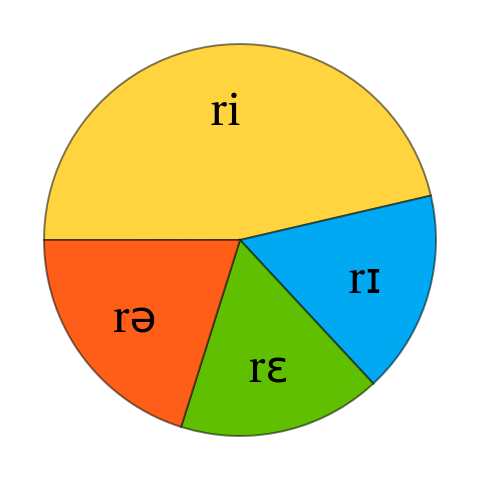
Details
Keys are the words; values are the list {ortho,phon}:
| ortho | the word as splled in English with "•" at each syllable break |
| phon | the phonetic representation with "•" at each syllable break |
Syllabification follows the Maximal Onset Principle (co•nnect) except where pronunication is strongly influenced by morphology (dis•arm).
The letter "x" in ortho often represents two distinct phonemes in phon that would span a syllable break. In these cases, the orthographic representation is preserved and one phoneme is moved to keep the x sounds together, as in {ex•tra, ˈɛks•trə},
Phonetic transcription follows the style of
WordData[w,"PhoneticForm"], in which primary and secondary stress markers ( ˈ and ˌ ) occur immediately before the nucleus of the syllable.
To match the style of
WordData[w,"PhoneticForm"], the English r-sound is represented with the[r] symbol, not the IPA standard[ɹ].
The syllable breaks in ortho correspond to the syllable breaks in phon, so each syllable may be compared to its phonetic representation.
In ortho, every word has exactly 1 primary stress except for single-syllable function words that would likely be unstressed in connected speech (e.g., to, the, his).
No two consecutive syllables are marked with the schwa symbol ə.
The phonetics transcribe a General American pronunciation biased toward Southwestern US.






![Intersection[WordData[], Keys[\!\(\*
TagBox[
RowBox[{"ResourceObject", "[", "\"\<Syllabified English Words\>\"", "]"}],
#& ,
BoxID -> "ResourceTag-Syllabified English Words-Input",
AutoDelete->True]\)]] // Length](https://www.wolframcloud.com/obj/resourcesystem/images/da9/da9932fc-a66f-4cc3-a4f9-ac8a9d786db3/6dbf9d7774607601.png)

![StringSplit[StringDelete[#[[2]], "ˈ" | "ˌ"], "\[Bullet]"] & /@ Values[ResourceData[\!\(\*
TagBox["\"\<Syllabified English Words\>\"",
#& ,
BoxID -> "ResourceTag-Syllabified English Words-Input",
AutoDelete->True]\)]] // Flatten // DeleteDuplicates // Length](https://www.wolframcloud.com/obj/resourcesystem/images/da9/da9932fc-a66f-4cc3-a4f9-ac8a9d786db3/0650710bb400a2a1.png)

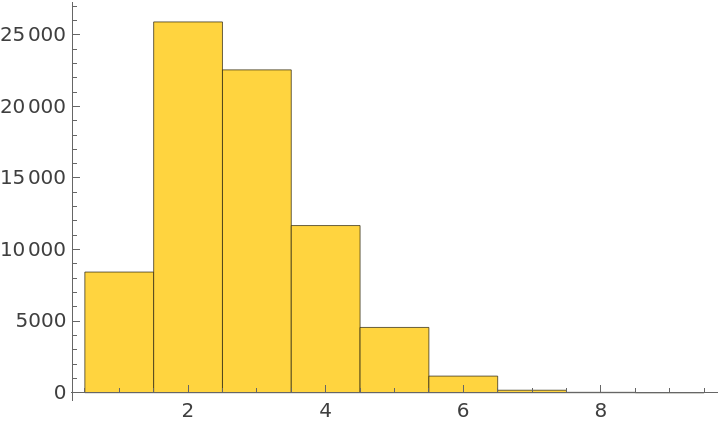
![sylCts = Length[StringSplit[#[[1]], "\[Bullet]"]] & /@ Values[ResourceData[\!\(\*
TagBox["\"\<Syllabified English Words\>\"",
#& ,
BoxID -> "ResourceTag-Syllabified English Words-Input",
AutoDelete->True]\)]];
Histogram[sylCts]](https://www.wolframcloud.com/obj/resourcesystem/images/da9/da9932fc-a66f-4cc3-a4f9-ac8a9d786db3/3d094f294350c778.png)
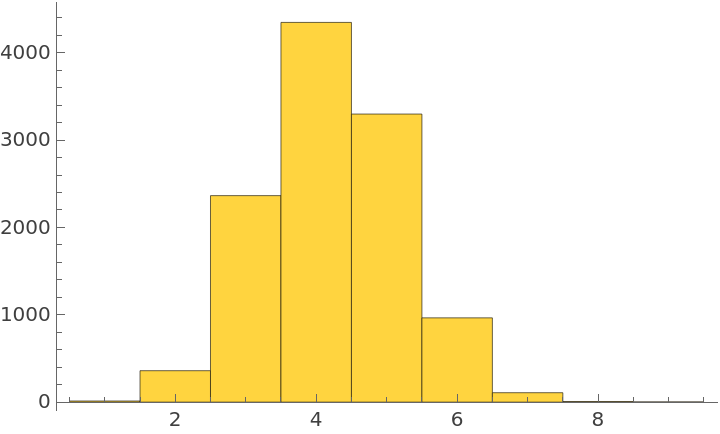
![syls = StringSplit[StringDelete[#[[2]], "ˈ" | "ˌ"], "\[Bullet]"] & /@ Values[ResourceData[\!\(\*
TagBox["\"\<Syllabified English Words\>\"",
#& ,
BoxID -> "ResourceTag-Syllabified English Words-Input",
AutoDelete->True]\)]] // Flatten // DeleteDuplicates;
Histogram[StringLength[syls]]](https://www.wolframcloud.com/obj/resourcesystem/images/da9/da9932fc-a66f-4cc3-a4f9-ac8a9d786db3/416c3bd0862a2873.png)
![wdPho = Cases[ResourceData[\!\(\*
TagBox["\"\<Syllabified English Words\>\"",
#& ,
BoxID -> "ResourceTag-Syllabified English Words-Input",
AutoDelete->True]\)], {a_, b_} /; StringStartsQ[a, "re\[Bullet]"] -> b];
cts = Counts[
StringDelete[StringSplit[#, "\[Bullet]"][[1]], "ˌ" | "ˈ"] & /@ wdPho];
PieChart[cts, ChartLabels -> Keys[cts], LabelStyle -> Directive[22, FontFamily -> "Times"], ImageSize -> 240]](https://www.wolframcloud.com/obj/resourcesystem/images/da9/da9932fc-a66f-4cc3-a4f9-ac8a9d786db3/4c60500b6bf68a7d.png)