Wolfram Data Repository
Immediate Computable Access to Curated Contributed Data
Radar echoes above an SNR threshold for a ground-based, atmospheric radar operating at 33.4 GHz
 .
. and ND(y)=β ΩbeamF3/ay-3/a. If the radar is omnidirectional and the entire hemisphere is illuminated then Ωbeam=2π. The fraction of targets that are detected at SNR values y>yT is the ratio of these two quantities, i.e. (yT/y)3/a. The cumulative fraction of targets detected as a function of the SNR value y is G(y)=1-(yT/y)3/a for y≥yT and zero otherwise. This is the cummulative probability density function of a Pareto distribution with decay parameter α=3/a and threshold parameter yT.
Retrieve the data as a TimeSeries object:
| In[1]:= | ![ResourceData[\!\(\*
TagBox["\"\<Universal Probability Density Function of Detected SNR\>\"",
#& ,
BoxID -> "ResourceTag-Universal Probability Density Function of Detected SNR-Input",
AutoDelete->True]\)]](https://www.wolframcloud.com/obj/resourcesystem/images/7a3/7a334e31-b67a-448a-a45e-8731ebd40ada/714411c0e192e5ea.png) |
| Out[1]= |  |
Visualize the data:
| In[2]:= | ![ListPlot[ResourceData[\!\(\*
TagBox["\"\<Universal Probability Density Function of Detected SNR\>\"",
#& ,
BoxID -> "ResourceTag-Universal Probability Density Function of Detected SNR-Input",
AutoDelete->True]\)], Sequence[
PlotRange -> {{0, 50}, All}, Axes -> False, Frame -> True, FrameLabel -> {"SNR (dB)", "Slant Range (m)"}]]](https://www.wolframcloud.com/obj/resourcesystem/images/7a3/7a334e31-b67a-448a-a45e-8731ebd40ada/3e2f2422f595d094.png) |
| Out[2]= | 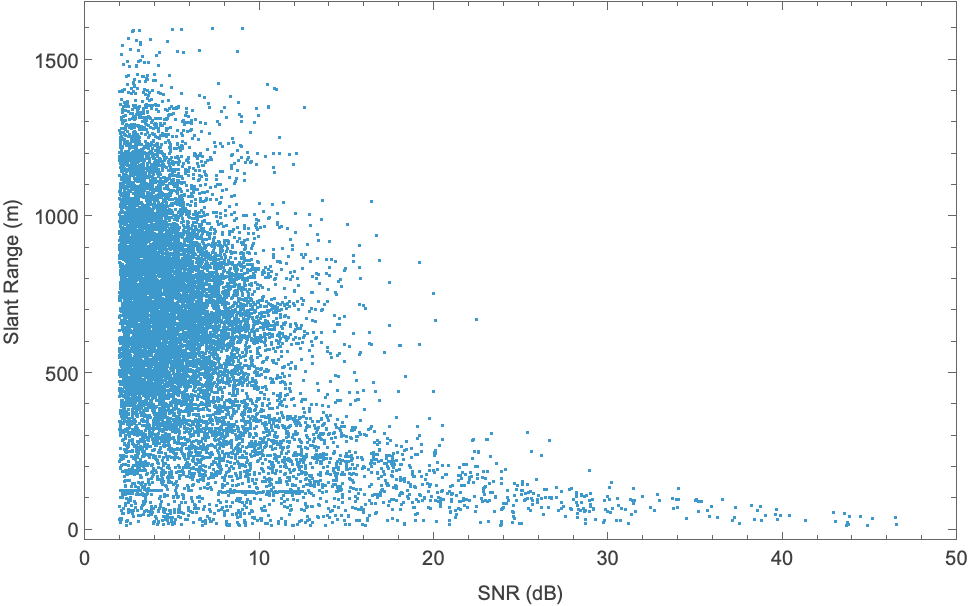 |
Extract the SNR portion of the data and fit the values to a Pareto distribution. Create a Histogram of the data and compare it to the probability density function of the fitted Pareto distribution:
| In[3]:= | ![data = Keys[ResourceData[\!\(\*
TagBox["\"\<Universal Probability Density Function of Detected SNR\>\"",
#& ,
BoxID -> "ResourceTag-Universal Probability Density Function of Detected SNR-Input",
AutoDelete->True]\)]];
data = 10^(data/10);
estdist = EstimatedDistribution[data, ParetoDistribution[k, \[Alpha]]];
g1 = Histogram[data, {0, 15, 0.4}, Sequence[
"PDF", Axes -> False, Frame -> True, FrameLabel -> {"SNR (power)"},
PlotRange -> All]];
g2 = Plot[PDF[estdist, y], {y, 0, 15}, Sequence[
Axes -> False, Frame -> True, FrameLabel -> {"SNR (power)"}, PlotRange -> All]];
Show[g1, g2]](https://www.wolframcloud.com/obj/resourcesystem/images/7a3/7a334e31-b67a-448a-a45e-8731ebd40ada/6d33546645eb1df6.png) |
| Out[8]= | 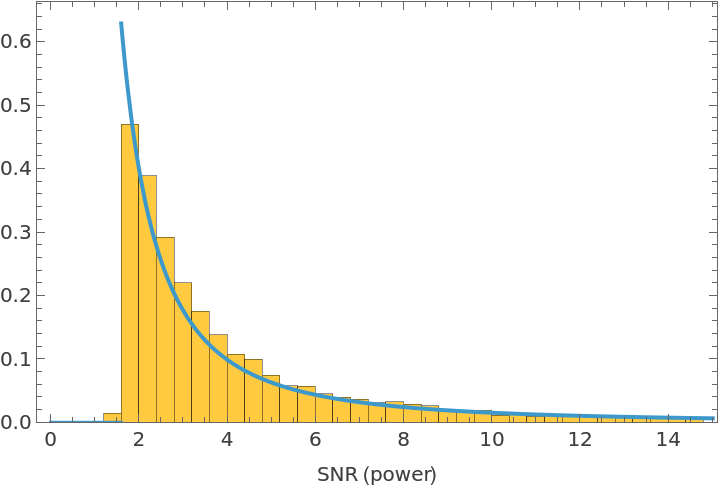 |
The implied range decay coefficient is a=3/α where α is the fitted Pareto parameter. The value is almost exactly 3:
| In[9]:= | ![3/estdist[[2]]](https://www.wolframcloud.com/obj/resourcesystem/images/7a3/7a334e31-b67a-448a-a45e-8731ebd40ada/203b685f7e6f8af6.png) |
| Out[9]= |  |
This implies 30log10r SNR range decay on a decibel scale in the data. This suggests that the range decay in the data is mid way between the weather radar equation (20log10r range decay) and the standard radar equation (40log10r range decay). An advantage of this technique is that it makes use of all the data and properly accounts for selection effects (thresholding).
Marshall Bradley, "Universal Probability Density Function of Detected SNR" from the Wolfram Data Repository (2026)