Wolfram Data Repository
Immediate Computable Access to Curated Contributed Data
More than 76,000 English words with syllable breaks
| ortho | the word as splled in English with "•" at each syllable break |
| phon | the phonetic representation with "•" at each syllable break |
Retrieve a subset of the data:
| In[1]:= | ![ResourceData[\!\(\*
TagBox["\"\<Syllabified English Words\>\"",
#& ,
BoxID -> "ResourceTag-Syllabified English Words-Input",
AutoDelete->True]\)][[1 ;; 10]]](https://www.wolframcloud.com/obj/resourcesystem/images/da9/da9932fc-a66f-4cc3-a4f9-ac8a9d786db3/3a0d60a7bbbe29bc.png) |
| Out[1]= |  |
Find the length of the data:
| In[2]:= | ![Length[ResourceData[\!\(\*
TagBox["\"\<Syllabified English Words\>\"",
#& ,
BoxID -> "ResourceTag-Syllabified English Words-Input",
AutoDelete->True]\)]]](https://www.wolframcloud.com/obj/resourcesystem/images/da9/da9932fc-a66f-4cc3-a4f9-ac8a9d786db3/73771f6a5a962ea6.png) |
| Out[2]= |  |
Retrieve one record from the data:
| In[3]:= | ![ResourceData[\!\(\*
TagBox["\"\<Syllabified English Words\>\"",
#& ,
BoxID -> "ResourceTag-Syllabified English Words-Input",
AutoDelete->True]\)]["connect"]](https://www.wolframcloud.com/obj/resourcesystem/images/da9/da9932fc-a66f-4cc3-a4f9-ac8a9d786db3/7e4a0878056808e6.png) |
| Out[3]= |  |
Check how many words also belong to WordData:
| In[4]:= | ![Intersection[WordData[], Keys[ResourceData[\!\(\*
TagBox["\"\<Syllabified English Words\>\"",
#& ,
BoxID -> "ResourceTag-Syllabified English Words-Input",
AutoDelete->True]\)]]] // Length](https://www.wolframcloud.com/obj/resourcesystem/images/da9/da9932fc-a66f-4cc3-a4f9-ac8a9d786db3/0507dbac11d3a661.png) |
| Out[4]= |  |
Count the number of unique syllables regardless of stress:
| In[5]:= | ![StringSplit[StringDelete[#[[2]], "ˈ" | "ˌ"], "\[Bullet]"] & /@ Values[ResourceData[\!\(\*
TagBox["\"\<Syllabified English Words\>\"",
#& ,
BoxID -> "ResourceTag-Syllabified English Words-Input",
AutoDelete->True]\)]] // Flatten // DeleteDuplicates // Length](https://www.wolframcloud.com/obj/resourcesystem/images/da9/da9932fc-a66f-4cc3-a4f9-ac8a9d786db3/0128f65f2725df9c.png) |
| Out[5]= |  |
Visualize the syllable counts of all words in the data:
| In[6]:= | ![sylCts = Length[StringSplit[#[[1]], "\[Bullet]"]] & /@ Values[ResourceData[\!\(\*
TagBox["\"\<Syllabified English Words\>\"",
#& ,
BoxID -> "ResourceTag-Syllabified English Words-Input",
AutoDelete->True]\)]];
Histogram[sylCts]](https://www.wolframcloud.com/obj/resourcesystem/images/da9/da9932fc-a66f-4cc3-a4f9-ac8a9d786db3/11654b93c78affb0.png) |
| Out[7]= | 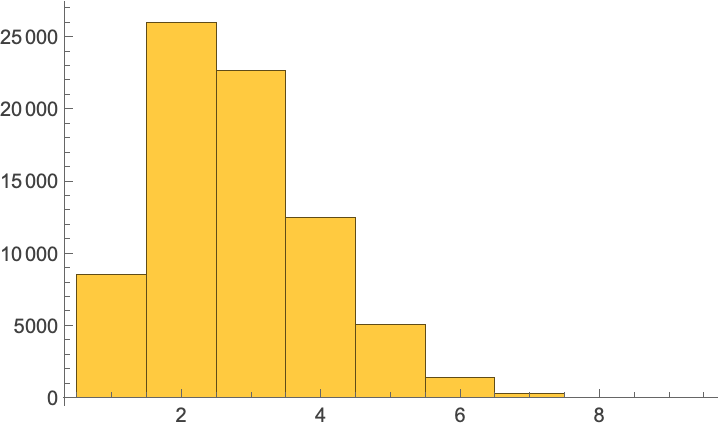 |
Visualize the phoneme counts of all unique syllables in the data:
| In[8]:= | ![syls = StringSplit[StringDelete[#[[2]], "ˈ" | "ˌ"], "\[Bullet]"] & /@ Values[ResourceData[\!\(\*
TagBox["\"\<Syllabified English Words\>\"",
#& ,
BoxID -> "ResourceTag-Syllabified English Words-Input",
AutoDelete->True]\)]] // Flatten // DeleteDuplicates;
Histogram[StringLength[syls]]](https://www.wolframcloud.com/obj/resourcesystem/images/da9/da9932fc-a66f-4cc3-a4f9-ac8a9d786db3/28c74dd4e8640dc8.png) |
| Out[9]= | 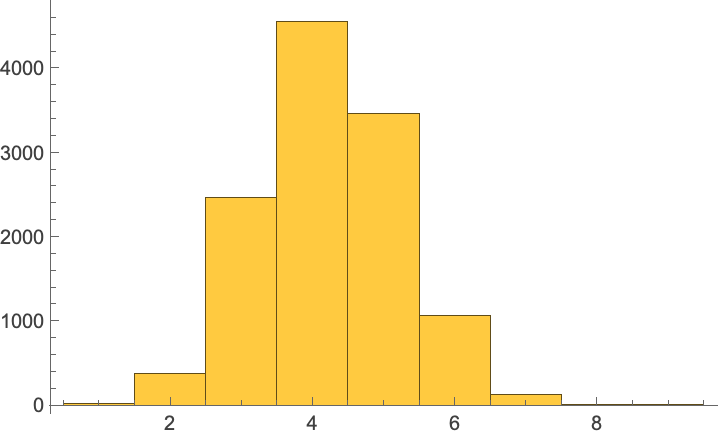 |
Mark Greenberg, "Syllabified English Words" from the Wolfram Data Repository (2026)